


Which Animals Have Gone to Space?
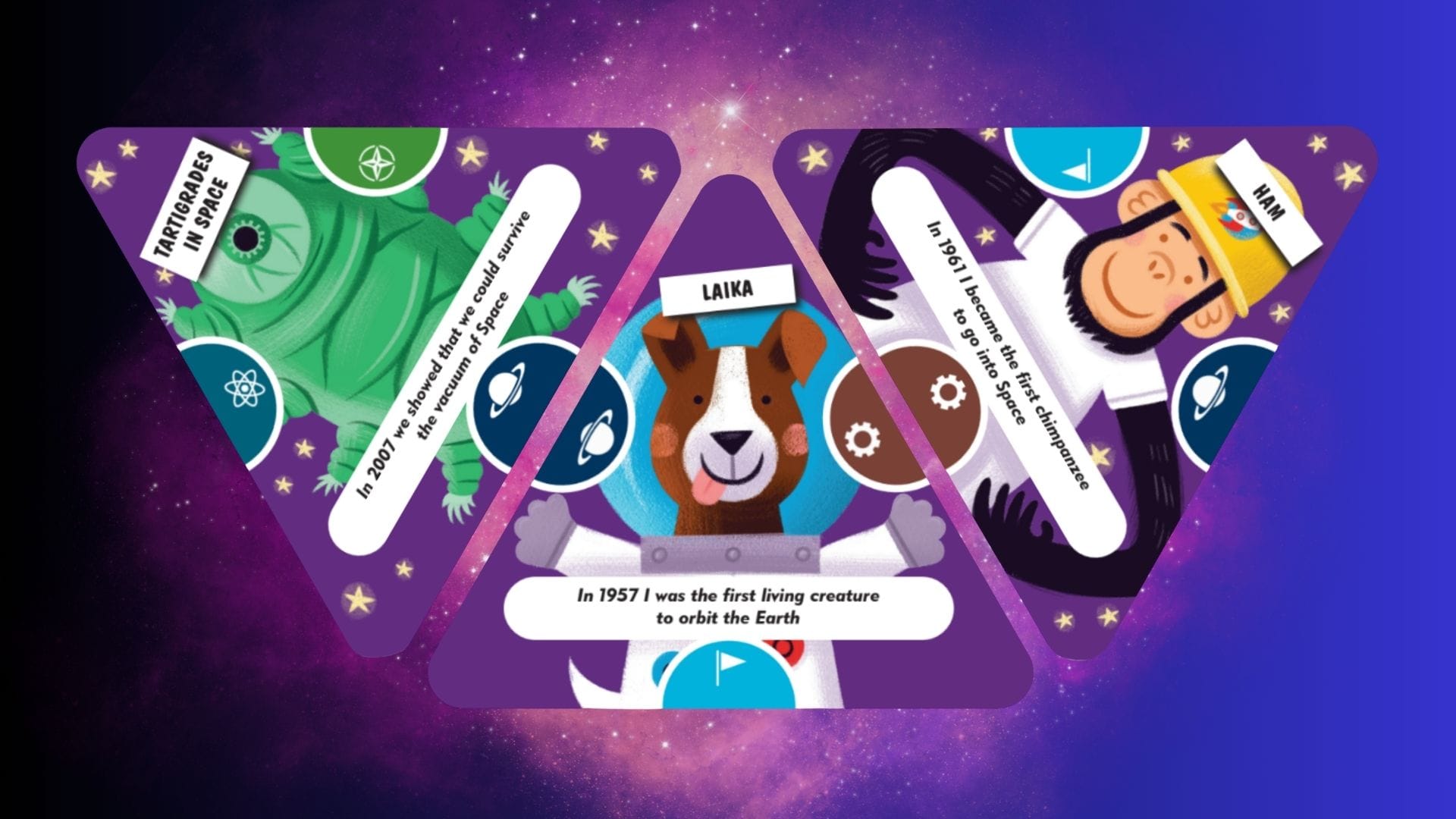
When we think about space explorers, we usually picture the likes of Neil Armstrong in his spectacular space suit (Joker fact: it was made by a bra manufacturer!) and the other human heroes of space history. In fact, we made a whole card game about space heroes, the History Heroes SPACE card game. But did you know, some of the very first space travellers from earth had fur, paws and even microscopic claws? Before humans blasted into orbit, brave animals took the first risky journeys into space. Let’s meet the incredible animals who embarked on pioneering journeys, including three Animal Heroes from our A LITTLE SLICE OF ANIMAL HISTORY card game.
History Heroes from A LITTLE SLICE OF ANIMAL HISTORY
 Ham: The First Chimp in Space

In 1961 I became the first chimpanzee to go into Space
Before humans dared orbit Earth, a young chimpanzee named Ham did it first! Ham was one of 40 chimps chosen for the space program, trained to pull levers in response to sound and light. If they responded correctly, they were rewarded (with bananas, of course) but if they did not, they received a small electrical shock to the bottom of their feet. In 1961, Ham blasted off in NASA’s Mercury capsule and safely returned, proving that primates could survive spaceflight. After the amazing Ham returned to earth, he went to live at the Smithsonian’s National Zoo in Washington DC until 1980 when he was moved to the North Carolina Zoological Park. Ham died in 1983. A truly remarkable Astrochimp and iconic Animal History Hero from the A LITTLE SLICE OF ANIMAL HISTORY card game.
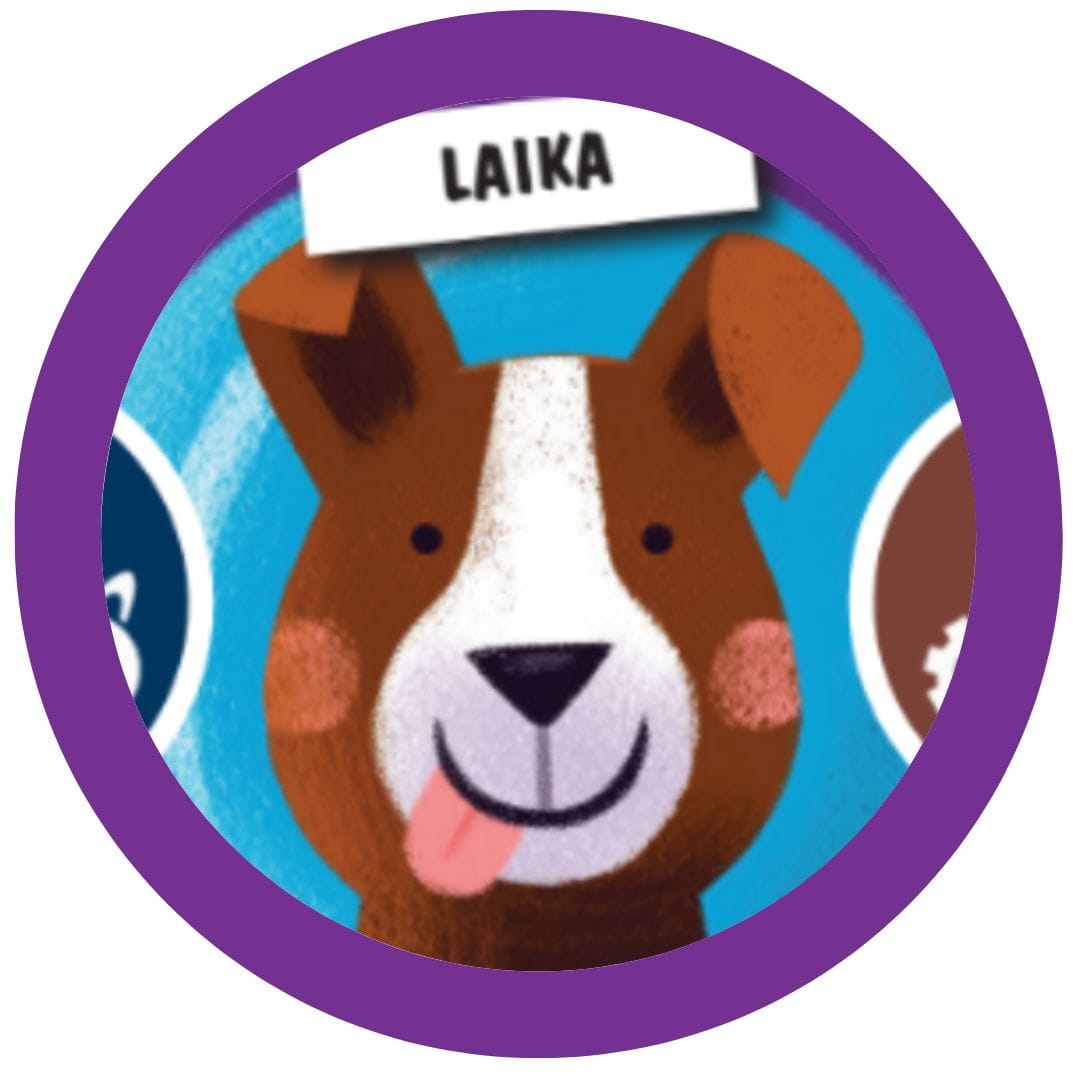
 Laika: The Dog Who Touched the Stars
In 1957 I was the first living creature to orbit the Earth
Laika, a stray from Moscow’s streets, became the first animal to orbit Earth in 1957 aboard Sputnik 2. The Soviets recruited a group of female dogs to run tests to measure their obedience and test their reactions to living in pressurised capsules to simulate what it would be like in a spacecraft. Laika was deemed the most suitable, and therefore was chosen as the first dog in space, but it was a sad selection as it meant certain death. Sputnik 2 launched on November 3rd 1957 and was the second spacecraft to reach Earth’s orbit. Tragically, Laika died within hours of her takeoff due to overheating. Laika took one giant leap, and sacrifice, in paving the way for human spaceflight. A very worthy pawed hero who deserves to be remembered. Find Laika’s card in the A LITTLE SLICE OF ANIMAL HISTORY card game.
 Tardigrades in Space: Microscopic Survivors

In 2007 we showed that we could survive the Vacuum of Space
Tardigrades, or “water bears,” are microscopic creatures capable of surviving extreme heat, cold and radiation. In 2007, they showed they could even survive the vacuum of space! They were sent to space on the European Space Agency’s Foton-M3 mission for 12 days. Their survival for this long proved they were hardy organisms able to withstand incredibly extreme conditions. On earth, tardigrades can be found all over the world, from the deep sea to mountain tops and back gardens. There are over 1,000 species of tardigrades, all with eight clawed legs, and they are usually only seen under a microscope. Find the Tardigrades in Space card in the A LITTLE SLICE OF ANIMAL HISTORY card game.
Other Amazing Animal Astronauts!
Belka and Strelka: The First Space Dogs to Safely Return to Earth
In 1960, two stray dogs named Belka (meaning Squirrel) and Strelka (meaning Little Arrow) became the first animals to orbit Earth and, unlike their brave predecessor Laika, return safely. They travelled aboard the Soviet spacecraft Sputnik 5 alongside two rats, a rabbit, fruit flies and plants. Soviet space scientists preferred working with dogs because they were easier to train than monkeys and chimps (the Americans’ preferred animal astronauts). After 17 orbits of Earth, Belka and Strelka returned to Earth and hopped out of their spacecraft unharmed. They were immediate heroes, working the international celebrity circuit. Belka and Strelka’s mission helped pave the way for the first human spaceflight just one year later! Want to learn more about Space History? Check out the History Heroes SPACE card game.
Albert II: The First Monkey in Space
Albert II was a rhesus monkey who became the first monkey to reach space in 1949. He travelled aboard a United States rocket as part of early experiments to understand travelling to space can affect living bodies. Albert II reached an altitude of 83 miles, high enough to be considered space, making him a true space pioneer. Tragically, Albert II did not survive his journey due to a parachute malfunction on his return to earth. He was the first monkey in space, and a true hero who made an unwilling sacrifice to progress the development of space exploration. You can learn all about Space History in the History Heroes SPACE card game!
The Moon Tortoises: First Animals to Orbit the Moon
In 1968, two tortoises became the first animals from earth to travel around the Moon. They flew aboard a Soviet spacecraft called Zond 5 alongside plants, seeds and bacteria, and spent a week in space circling the moon before returning safely to earth. The tortoises survived the journey with only small changes to their bodies. They may be famous for their slow and steady steps but this was a pretty massive leap for tortoise-kind!
These stories are amazing, sometimes sad, and always important. Thanks to these remarkable animals and their unwilling sacrifices, humans learned valuable lessons that led to safer space travel and crucial scientific discoveries bringing us closer to understanding our universe and our place in it.
Have fun and challenge your chums with Ham, Laika and the Tardigrades in Space with our fantastic card game A LITTLE SLICE OF ANIMAL HISTORY.